
One platform for the whole school – and for every way of learning.
eldr brings together what schools have so far kept in separate systems: learning, content and organisation. Your school starts where it stands today – and grows from there on the same platform.
- GDPR-compliant
- EU hosting (Hetzner, Germany)
- Built in Germany, for German schools
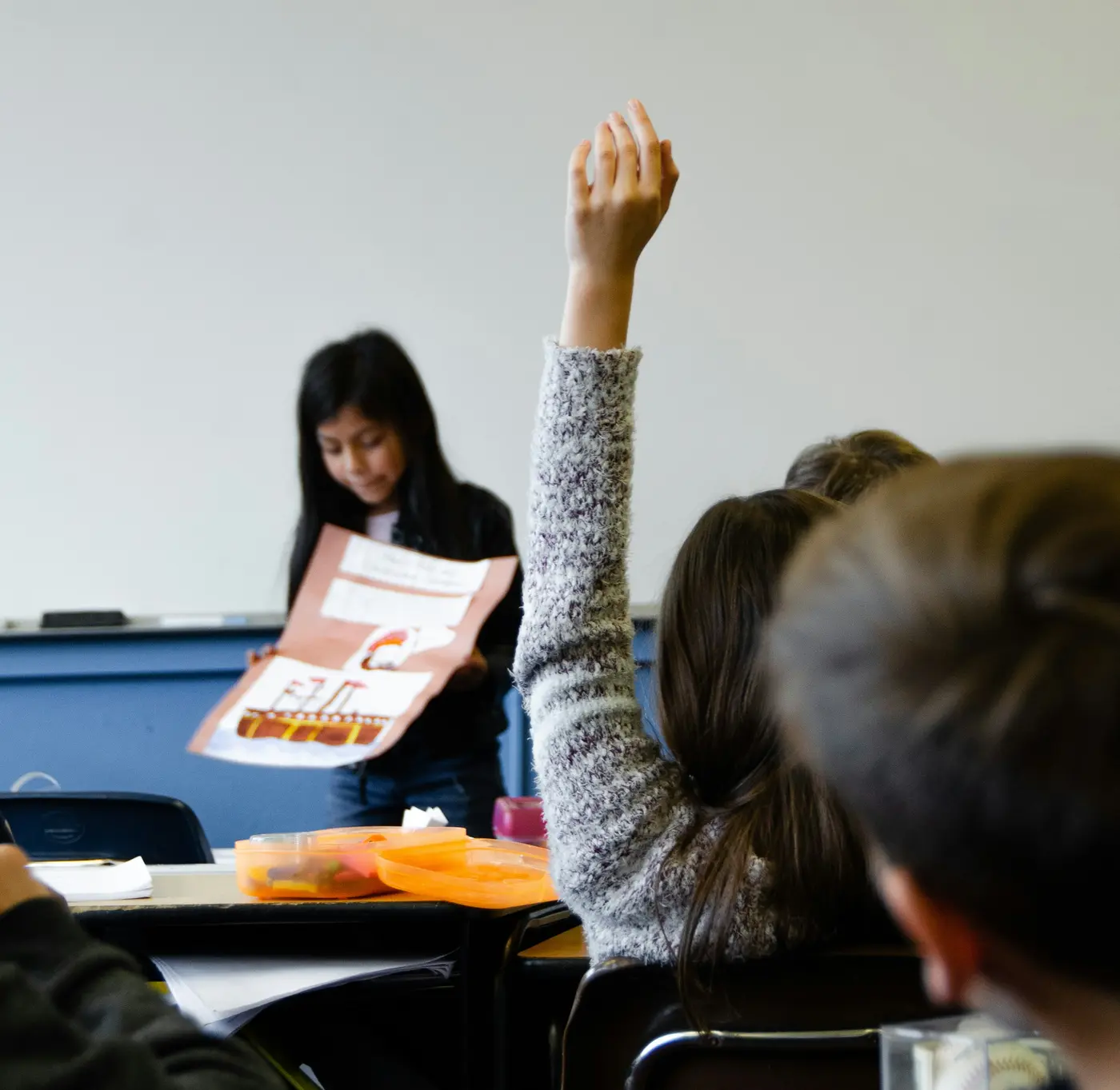
Not a platform for one single pedagogy.
eldr is not tied to one teaching concept. It carries many ways of learning – from classic lessons to fully self-organised learning, and every step in between. The same subject matter can be offered as a step-by-step path or as an open project, depending on the group.
Learning
A workspace for learners and one for teachers: learning packages, coaching, proof of skills and a learning record that grows along the way.
Content
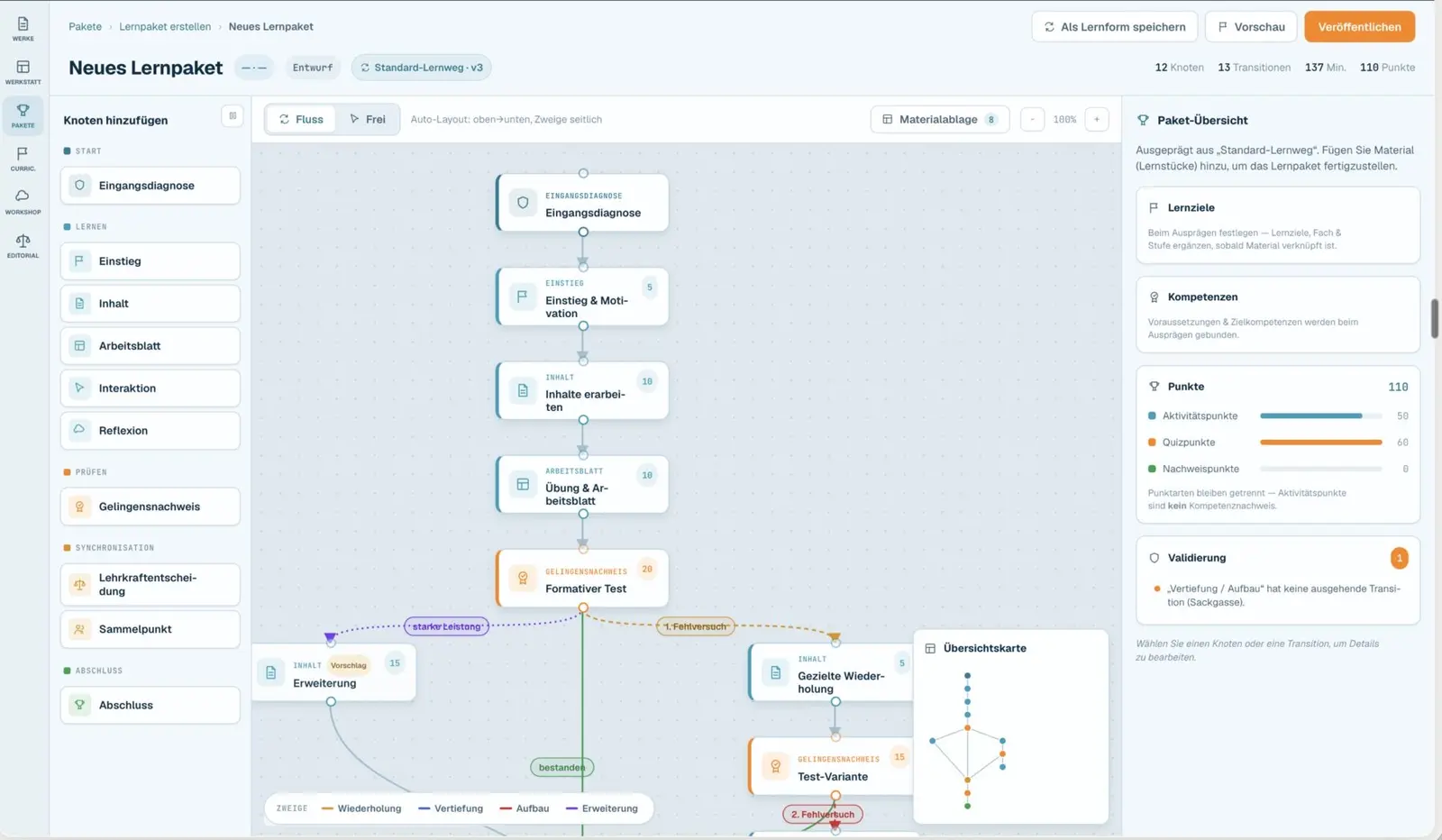
One shared workshop for material: worksheets, learning packages and competency grids in one place – with AI support and quality review.
Organisation
Pupil and staff records, rooms, timetables, cover planning, parents and data exchange with the education authority – in the same system.
One platform, five perspectives – every role sees what it needs.
Learners, teachers, parents, material authors and school leadership work in one system. Each role has its own view, and everyone sees the same, current picture – no retyping between programs.
Lernraum
For learners
A workspace of their own instead of a task list: learners see where they stand and plan their next steps themselves.
- Learning map
- Learning runs at their own pace
- Weekly planning
- Proof of skills and reflection
Lernbegleitung
For teachers
The day starts with what learners need – not with the class register.
- Cockpit with requests and approvals
- Traffic light for progress
- Coaching conversations
- Feedback and approving proofs of skill
Guardian
For parents
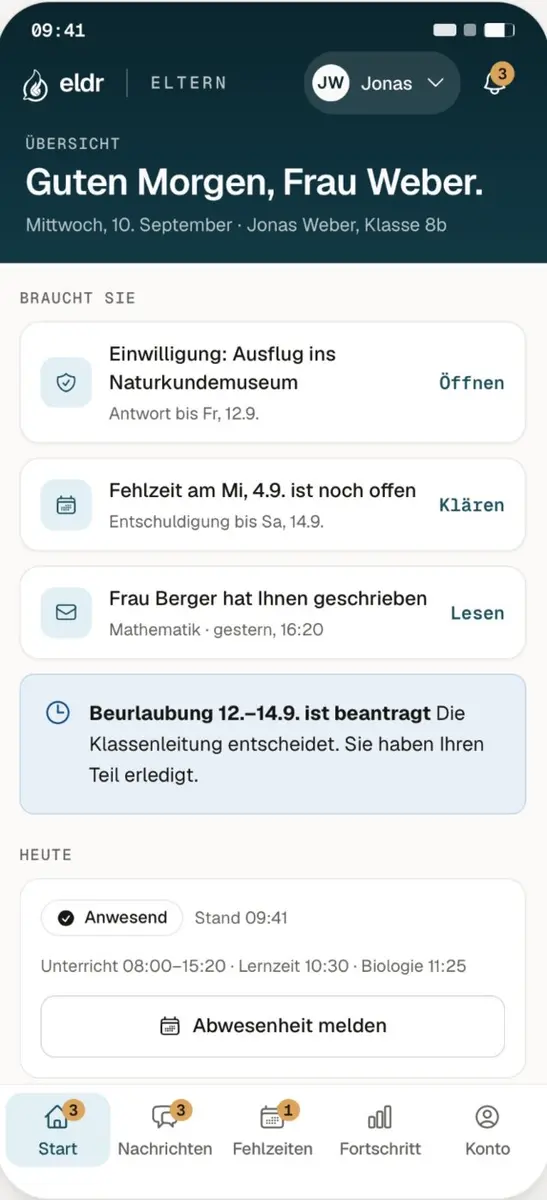
Parents see what their child chooses to share – progress, dates and conversations in one place.
- Progress in learning levels
- Dates and deadlines
- Messages with context
- Sick notes and notices
Lernwerk
For material authors
Existing material moves in with you and is developed further together – instead of being rebuilt at every school.
- Bring your material
- Competency grid as structure
- AI workshop
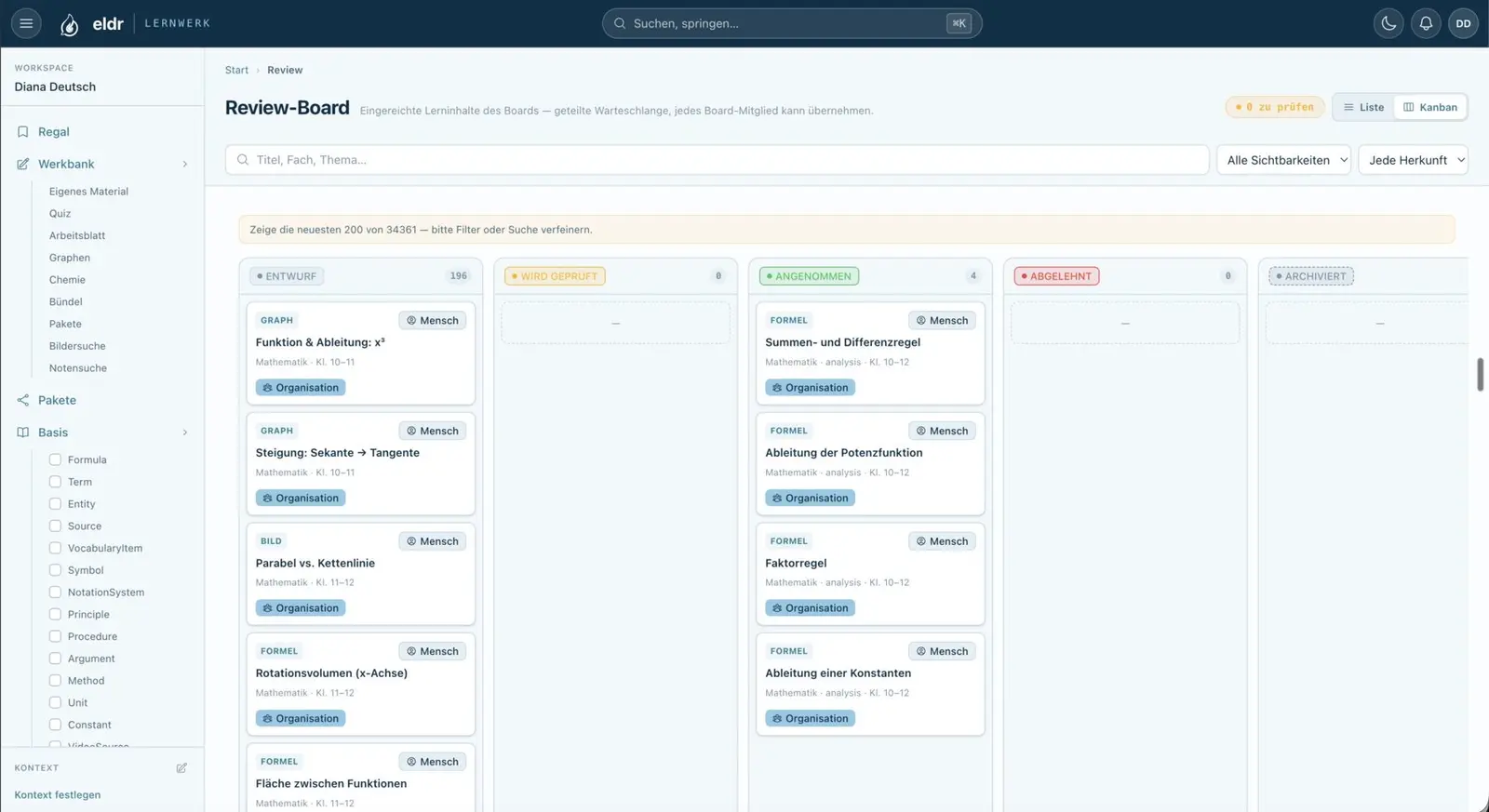
- Quality review board
Manage
For school leadership & office
Organisation follows pedagogy: rooms, times and staff are managed where the learning happens.
- Pupil and staff records
- Rooms and timetables
- Cover planning
- Data exchange with the authority
Learners choose when they are ready.
In the Lernraum, pupils work on learning packages – self-contained units with an entry check, content, practice and a proof of skill. They see where they stand, set their own goals and help decide when to show what they can do.
-
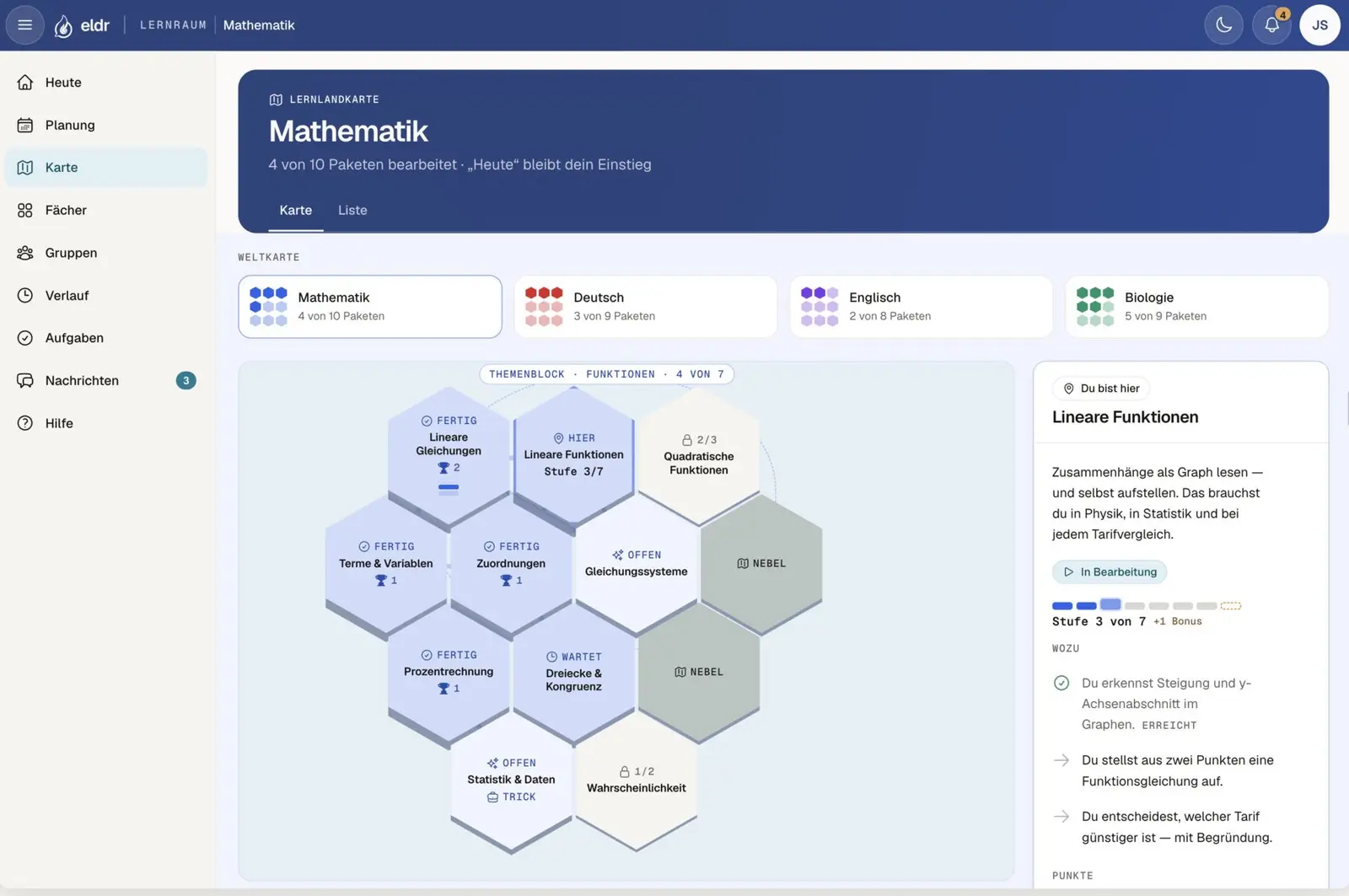
Learning map. The competency grid as a map: each field is a learning package, links show what builds on what. Done, in progress, open – at a glance.
-
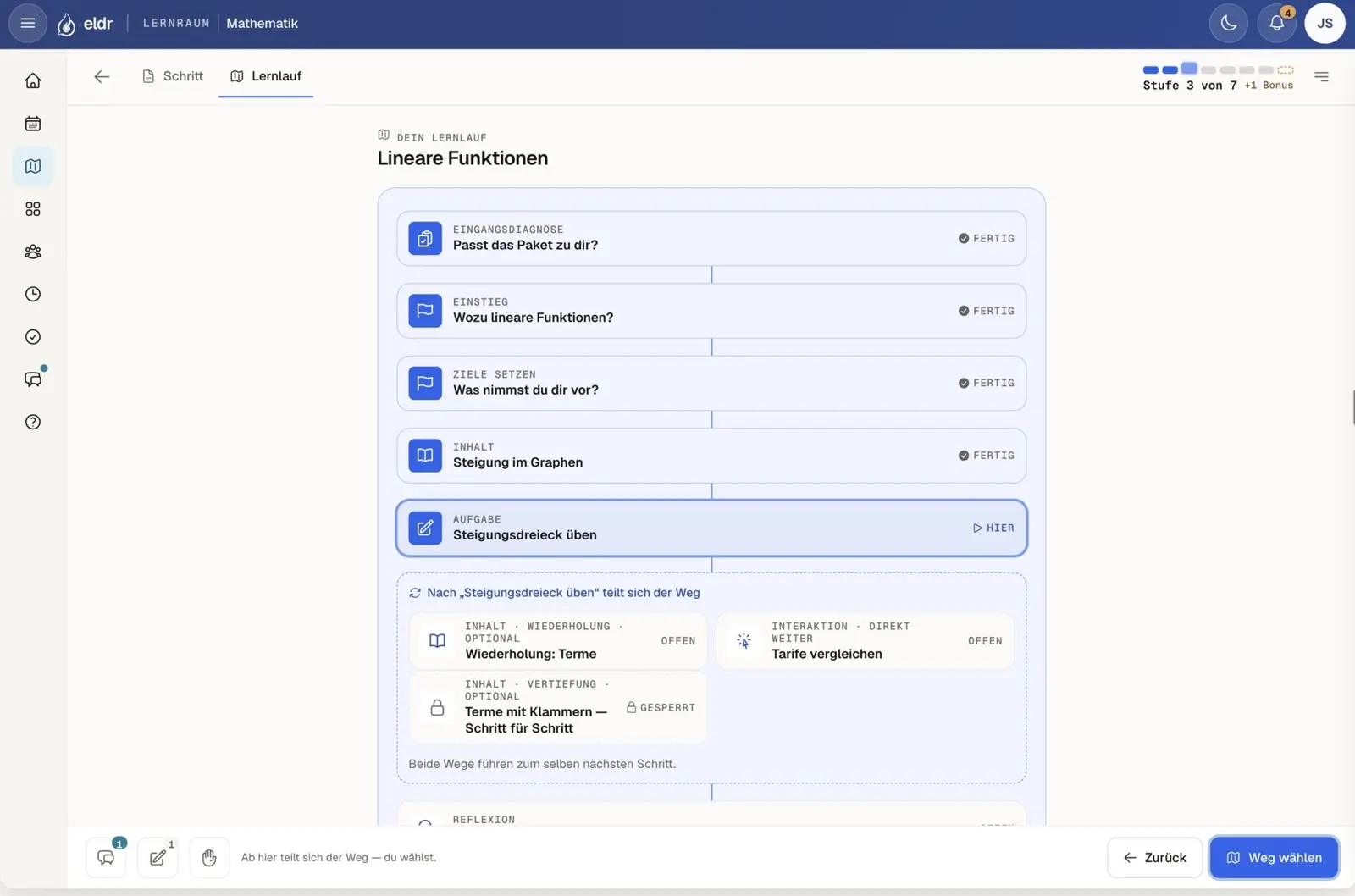
Learning run. Working through a learning package at one's own pace: from the entry check through personal goals to reflection. Every stage is visible.
-
Proof of skill. When learners feel ready, they check with their teacher that everything is done. Date, place and expectations are on one page. A successful proof goes into the learning record; otherwise the next attempt follows with clear feedback.
-
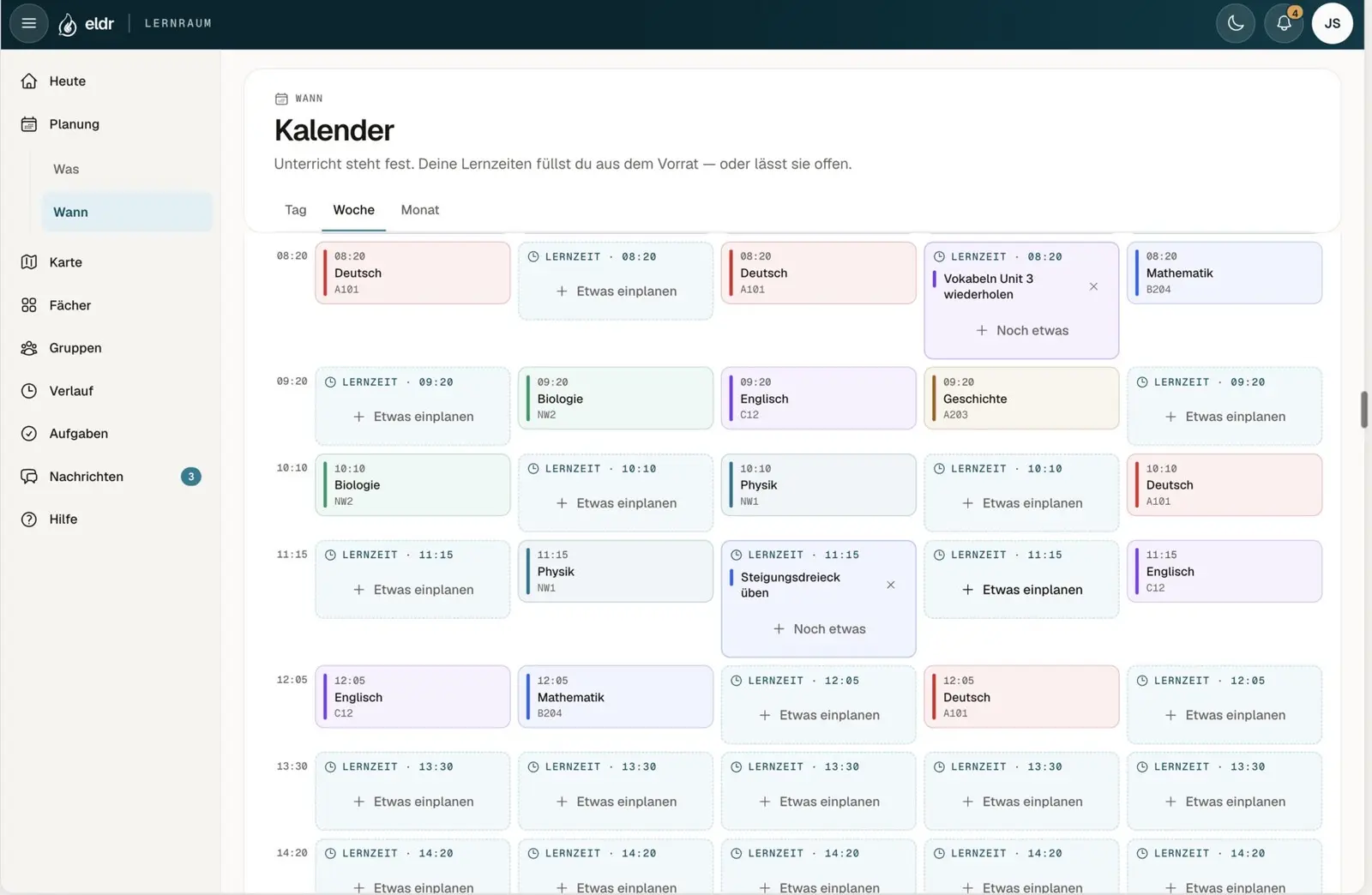
Weekly planning. Learners fill their own study time. Input sessions, meeting points and coaching are fixed; they plan the rest. The teacher sees the week without dictating it.
A traffic light instead of a mark sheet – so there is time to talk.
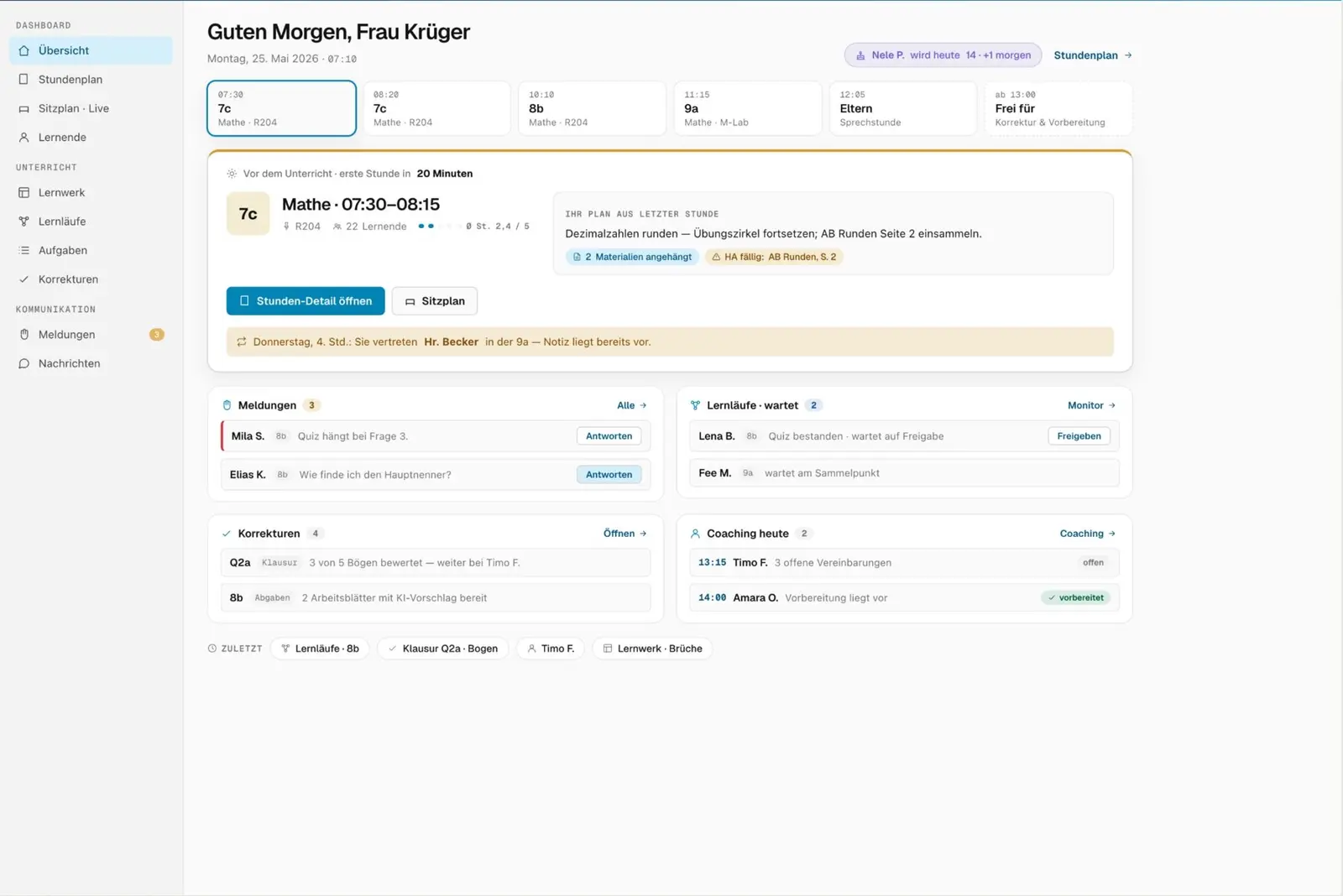
Lernbegleitung is the teacher's workspace. It shows who needs help, who is ready for a proof of skill and who would like a conversation – before anyone has to ask.
-
Cockpit. The day starts with open requests, waiting learning runs, approvals and coaching appointments – sorted by what needs attention, not alphabetically.
-
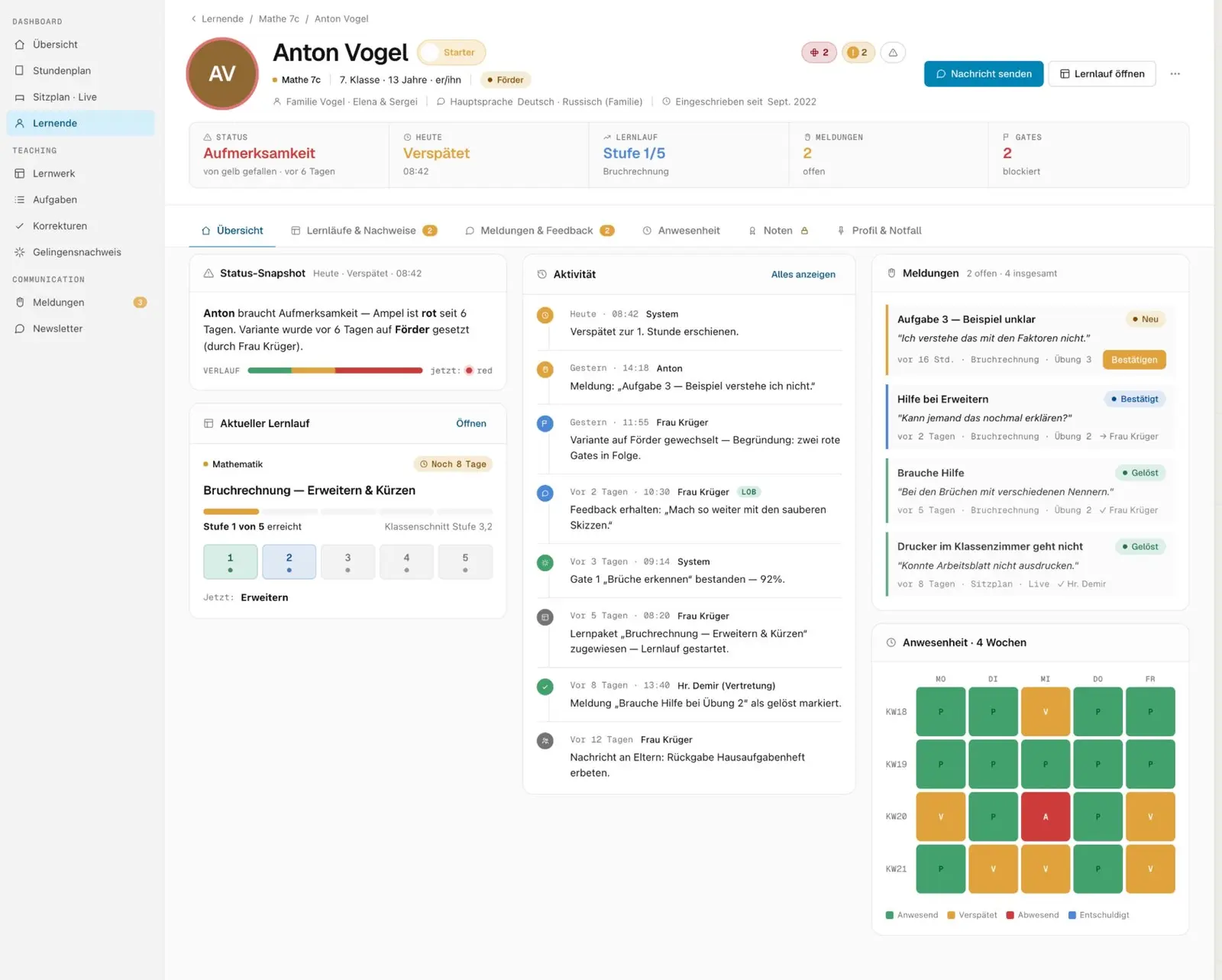
Ampel. Attendance, progress, open tasks and requests for each learner on one page. Marks sit behind a separate approval; day to day, it is about skills.
-
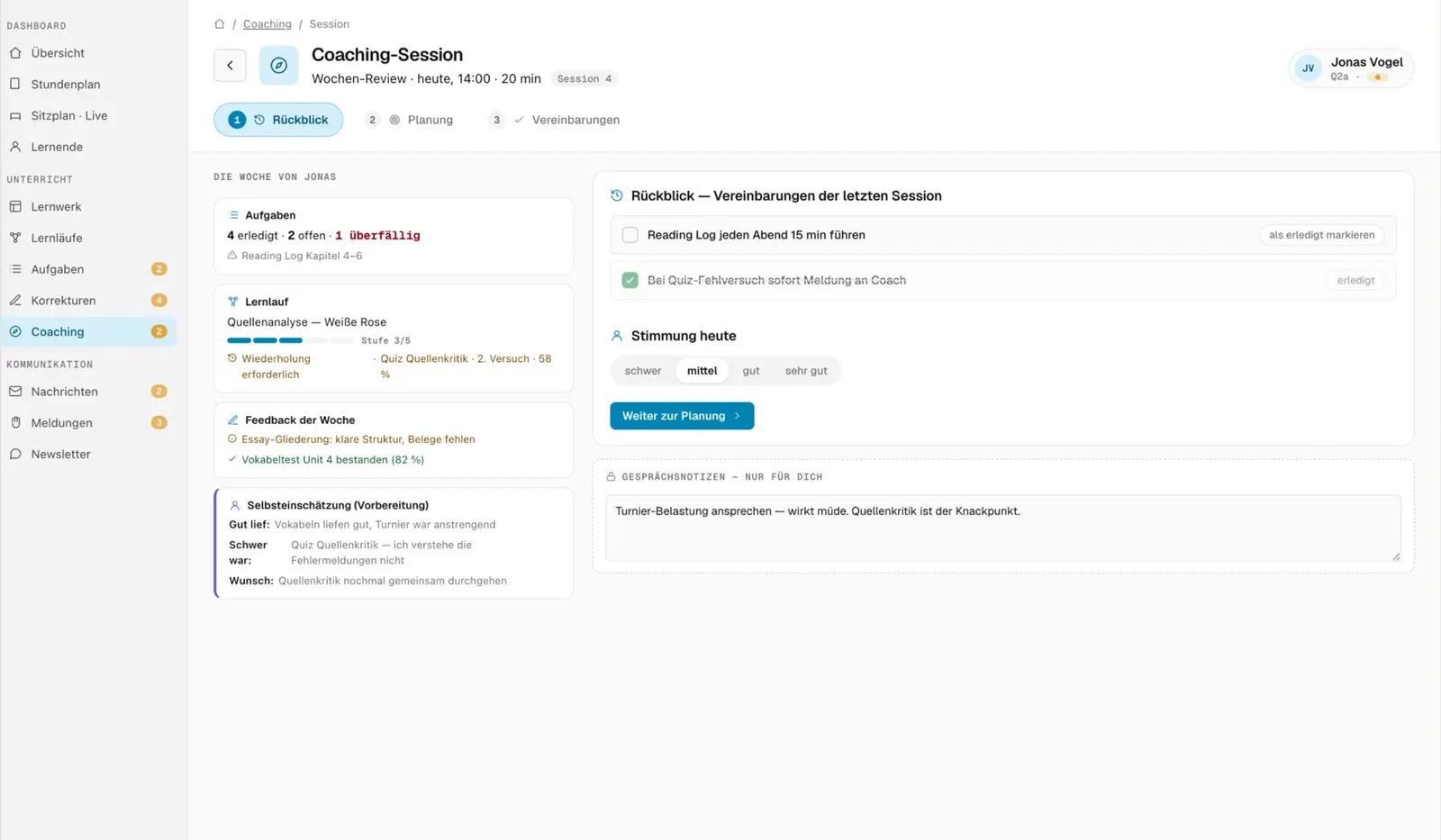
Coaching. Short conversations with a look back, how the learner feels and what was agreed. Agreements become tasks with a date and come back at the next conversation.
-
Accommodations built in. Extra time, read-aloud, dictation or fewer tasks are set once in the profile and then apply everywhere.
Import, don't rebuild: your material moves in with you.
Lernwerk is where the school's material lives – and existing material comes along. What authors publish there is immediately available for teachers to assign.
-
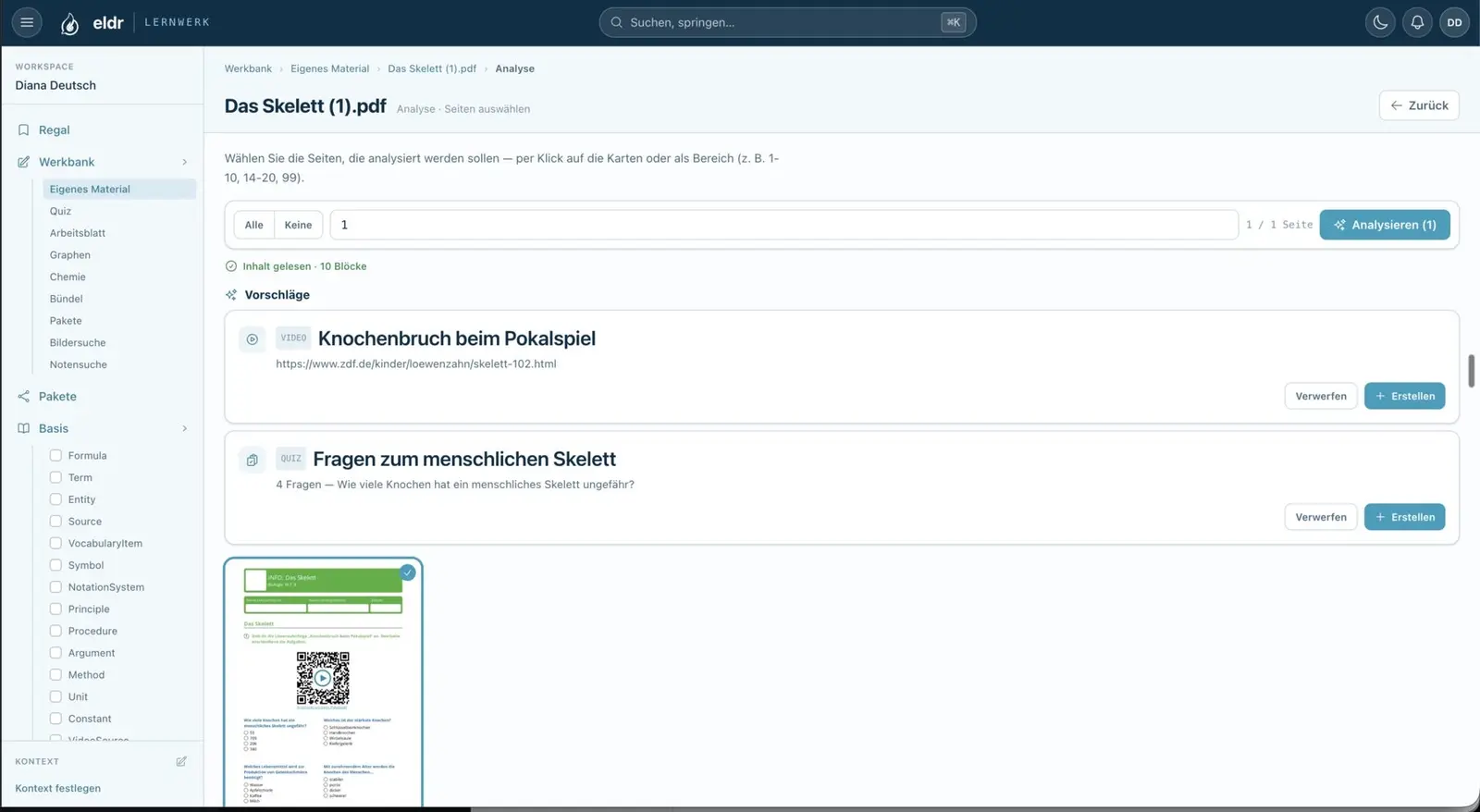
Bring what you have. Existing learning packages and worksheets are imported with licence, author and origin. The original source stays – eldr becomes the workshop.
-
KI-Werkstatt. Upload a worksheet and the AI suggests quiz questions and tasks. The teacher accepts or discards them – and remains the author.
-
Review-Board. Shared material is reviewed before wide use – including by teachers from other schools. Every item has a status and an owner.
-
One topic, several levels. Learning packages come in basic, intermediate and advanced versions, with built-in branches for revision and going deeper.
Responsibility, not surveillance.
In the Guardian parent app, learners decide which subjects and proofs of skill their parents see. Progress shows as a learning level, not a mark. Messages are linked to a learning package or appointment, so the teacher knows straight away what it is about. Sick notes and notices with read confirmation go through the same app – instead of email chains. Several children, one account.
Every school starts where it stands.
-
1
Complementing
Classes, timetable and lessons stay as they are. Learning packages add to lessons; parents and administration are on board from day one.
-
2
Opening up
Fixed study periods in the weekly plan, tasks at several levels and, in some subjects, the first proofs of skill instead of class tests.
-
3
Self-organised
Learning map, own weekly planning, coaching groups and proofs of skill when learners are ready. Teachers become learning coaches.
-
4
Your vision
[What your school sees as its goal – to be defined with you.]
No change of system between stages. The same learning packages, the same learning record, the same roles – only the way of learning, the time structure and how much learners steer themselves change.
The teacher decides; the AI does the groundwork.
In eldr, AI prepares; it does not decide. It helps prepare material, suggest tasks and get marking ready. The teacher accepts or discards every suggestion.
Feedback drafts
A draft and suggested grade per submission — the teacher edits and releases.
Phrase it more kindly
A growth-minded rephrasing suggestion — take it or leave it.
Dictate, don't type
Speak your feedback — even between two lessons.
Material in minutes
Paste Word or PDF — structure and competency suggestions come with it.
Data protection is built in, not a footnote.
GDPR-compliant
Personal data encrypted, role-based access, 2FA (roadmap).
EU hosting (Hetzner, Germany)
[Location & DPA details to be confirmed by eldr]
Marks protected
Grades sit behind a separate approval. Day to day, teachers see skills, and parents see only what learners share.
Traceable
Every change can be traced (roadmap).
Pilot schools, voices & metrics
[To be supplied by eldr after the pilot. Until then this honest empty state stays: no invented figures, no invented quotes.]
Adoption in four steps – no leap into the unknown.
-
1
Bring your material
We import your existing learning packages and worksheets instead of rebuilding them.
-
2
Pilot with one group
One learning group starts on eldr; the school gets to know the platform in everyday use.
-
3
[Pre-configured edition]
[What further schools or sites receive ready-made.]
-
4
Keep building together
You help decide what comes next.
What we build together.
What eldr brings
- Platform, operation, development and support – from one product team.
- Material import, AI workshop and school organisation in one system.
- A say in the roadmap: you prioritise what your school needs.
-
Dialog
A conversation, not a sales pitch
-
Pilot
Learning together
-
Partnership
Shared responsibility
The eldr team and the road to 2027
Four perspectives: teaching, organisation, technology and outreach – from schools and software development.
-

Martin Schmidt
Engineering & Product
-
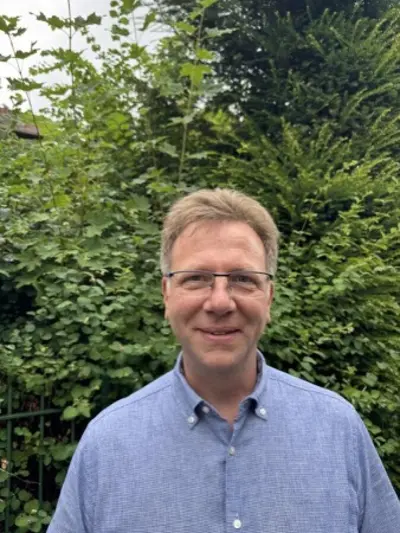
Matthias Akkermann
Teaching & Organisation
-

Michael Weber
School development, process facilitator
-

Eddy Dück
Sales & Marketing
-
2023
The AI era
With ChatGPT the question starts afresh: what should school be when knowledge is everywhere?
-
2024
The vision
eldr is born: a school platform for extended learning – Understand, Shape, Grow.
-
2025
Design & build
System design, building the team, domain model, five web apps, AI workshop.
-
2026
Beta & parallel operation
Pilot schools, feedback, preparing pre-configured editions.
-
2027
Expansion
[Partner schools, nationwide scale-up.]
Reorganising school – together.
We start with a conversation about your school: where it stands today and where it wants to go.